History of Apples at Hopewell Furnace
Prior to the mid-1800s most orchards in the United States were grown to produce cider and/or feed animals. As more horticultural organizations and literature became commonly accessible in the early 1800s, the knowledge and techniques necessary to produce more edible fruit expanded. By the late 1800s commercial orchards sought more dwarf size trees while focusing on a select number of varieties that reliably produced the most apples.
The earliest mention of an orchard at Hopewell Furnace is a 1788 Pennsylvania Gazette article highlighting the sale of the estate, describing it as "an excellent young bearing orchard of about 250 apple trees of the best fruit.” In the late 1700s at least one orchard existed on or near the furnace property including one in the general location of the present-day orchard. In the height of Hopewell’s operation (1820-1840) at least two distinct orchards existed on site. A peach orchard is known to have existed at Hopewell Furnace in 1835 and other orchards were owned by the furnace and rented to neighboring farmers. Furnace records indicated the sale of apple butter, dried apples, vinegar, and cider in the company store. Records also expressed that “trimming” of apple trees and picking of apples occurred in this period. In the decline of Hopewell’s operations (1846-1883) park records showed that the orchard was maintained, and that clover, oats, corn, and potatoes were cultivated among the trees.
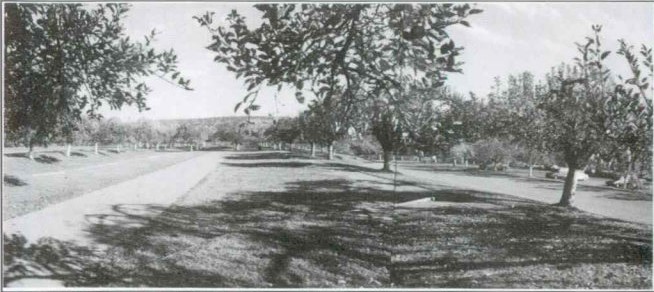
HOFU’s orchard is located where an orchard existed during the 18th and 19th century when the furnace was active. Restoration of the orchard began in December 1934, when the Civilian Conservation Corps began preparation of the grounds by clearing underbrush and other landscaping tasks. The planting of the current orchard was started by the National Park Service, with assistance from the Civilian Conservation Corps, in the section north of the old Reading/Valley Forge Road. Additions made in the 1960s and in 2000. The Park service began active maintenance of the orchard in the 1970s.
In 1944, to recreate the orchard at Hopewell from 1820-1840, Park Superintendent Emil Heinrich ordered apple trees from a local nursery in order to replicate the appearance of a historical apple orchard with 220-250 trees covering five acres. With all the existing apple trees in the park worm infested, Heinrich initially hoped secure unbudded, wild apple trees with good root systems and trunks suitable for growing larger trees and budding historical apple breeds. Unable to find them, a local expert suggested the park make due with budded trees, but plan to rebud them with the appropriate historical apples.
Superintendent Heinrich initially requested fifty apple trees from the WPA in ten different apple varieties, all tall enough that the fruit would be out of reach for rabbits and deer. In 1960 park maintenance planted another 150 trees and soon afterwards began an integrated pest management program involving seven sprays a year. Most research indicated that the trees historically grew high, but in the early 1960s, park leadership made the decision to top off the trees, perhaps for aesthetic reasons, a decision that was reversed soon afterwards. In the summer of 1967, NPS Horticulturalist David Moffitt reported that the Hopewell grounds looked “great,” except for rust disease on the rhododendron outside the Visitor Center and field mice damage to the apple trees. He recommended chemical treatment but suggested reducing the spray schedule to six times a year since human consumption was not a necessary concern.
From the time the government established the park, Hopewell’s staff advocated that the management of the orchard would reflect the preservation of the apple trees rather than that of fruit production. Visitors were free to pick apples until signs in 1981 reduced unauthorized fruit gathering because the activity caused too much damage to the orchard.
After the park’s annual Harvest Festival, the park invited visitors to collect those apples that had already fallen to the ground and donated the fruit to non-profit organizations. However, in 1986 the orchards helped make up for budget cuts when the park sold 20,000 pounds of apples (27 varieties) at $0.25 per pound to any member of the public who wanted to pick them from September through October. Over the next three years, the North Atlantic Region developed a policy for marketing fruit from all of the orchards within the National Park System.
In March 1988 Natural Resource Specialist John Apel drafted an orchard management plan to consider historically appropriate varieties of apples that would be “most resistant to disease and insects.” The regional survey counted 174 apple trees at Hopewell Furnace in 27 different varieties. Two seasonal positions, one full and one part-time, would be charged with establishing plots of vegetation, maintaining growth control, and collecting specimens. By 1999 the park charged $.50 a pound, with volunteer and employees allowed to pick up to ten pounds free.

________________________