Hopewell Furnace Apple Orchard
Purpose and Managment
Purpose and Managment
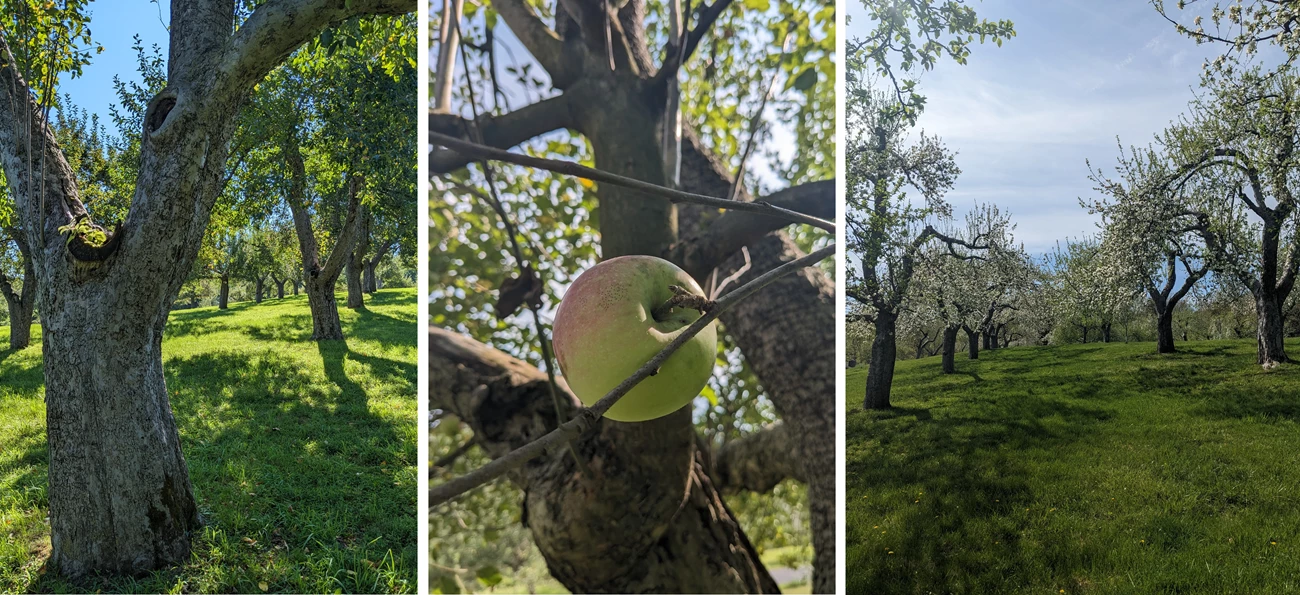
The National Park Service maintains Hopewell’s historic orchard utilizing a management plan developed by the park service run Olmstead Center for Landscape Preservation. The goal of Hopewell Furnace National Historic Sites’ orchard management is to give visitors a visual impression of what an orchard would have looked like in the 1800s transforming from a farm/cider orchard to a fruit orchard. Key visual characteristics are the spacing and physical appearance of the trees including taller trunks and higher, broader canopies. Maintaining these features contributes to preserving the historic landscape of HOFU. The current management strategy balances maintaining historic character with ongoing park operations like educational programs and the U-pick programs.
The trees get pruned regularly, usually in early spring. The goal of the pruning style is to emulate the tall tree canopies that would have been prevalent in 19th century orchards. In addition to pruning, the park manages disease, pests, and workplans to maintain the orchard on a yearly basis.
The management plan includes Integrated Pest Management (IPM) guidance which is a comprehensive strategy to achieve desired levels of pest control while limiting the use of chemicals. IPM recommendations include prescribed pruning techniques, which also preserve the historic appearance of the trees, and multiple applications of fungicide and miscible oil to protect the trees from various threats to the trees including Cedar Apple Rust and Fire Blight. These threats can affect overall tree health and apple production.
The management plan also provides for assessment of the health of individual trees in the orchard and targeted culling and replacement as appropriate to maintain the overall health and varietal diversity of the orchard. Information on the varities and locations of the Hopewell Furnace apple orchard trees can be found on the Apple Varieties page.
The annual yield of the orchard has varied in response to the pattern of rainfall, temperature and impacts from plant diseases. In recent years, average yields have been approximatly 2,000 lbs., though 2025 was reduced due to storms that passed through when the trees were in bloom. Apple trees also tend to display a natural pattern of alternating higher and lower yields.
Apple picking typically begins based on a Saturday in late September based on expected ripeness of variety of trees with apples. Picking tools are provided by the park and apples are sold by the pound.
Today, the orchard contains over 140 trees ranging from saplings to the CCC planted trees, which are approaching 100 years old! The National Park Service has actively managed Hopewell’s apple orchard since the 1970s.
_____________________