A Brief History of Apples in America
Apples were likely first domesticated in Central Asia. Owing to the hardiness of the trees and their adaptability to diverse climates, they quickly spread to the Middle East, Greece, and Rome – all of whom contributed to the species’ spread through their respective empires. A history of human development of the apple may be found at the following link:
With the exception of the wild sour crab apple, apples are not indigenous to North America. The first apple trees in North America grew from seeds brought by French Jesuits in the late sixteenth century and the attempted planting of trees in the Roanoke Colony in North Carolina (failed due to fire blight and cedar apple rust in hot wet environment). Attempts to grow apples in Jamestown were not successful due to the clayey soils.
The Pilgrims brought young apple trees from England in the 1620s and planted orchards throughout New England. In the first years of settlement, Pilgrims grafted shoots of European apples onto the rootstock of native crab apples. With Lord Baltimore’s encouragement, over 90% of farms in Maryland had orchads by the mid 17th century. Fruit, including apples, pears (also introduced by the Jesuits), and plums, was a staple food among the Iroquois of the Mohawk Valley of New York in the 18th century.
John Endicott planted the first commercial nursery in Salem, Massachussetts in 1629. His operation propogated ten thousand trees a year by whip grafting. Peter Stuyvesant planted an orchard of 40 varieties from the Netherlands in the Bowery (Dutch for farm) in Lower Manhattan in 1647. The LaSalle expedition (from French Canada) planted thousands of apples in the Mississippi Valley in 1679-82. The Prince Nursery was founded in Flushing, New York in 1730 and grew to become one of the largest early commercial nurseries, visited by each of the first four US Presidents. Thomas Jefferson was a customer for his planting of 170 varieties at Monticello for scientific observation.
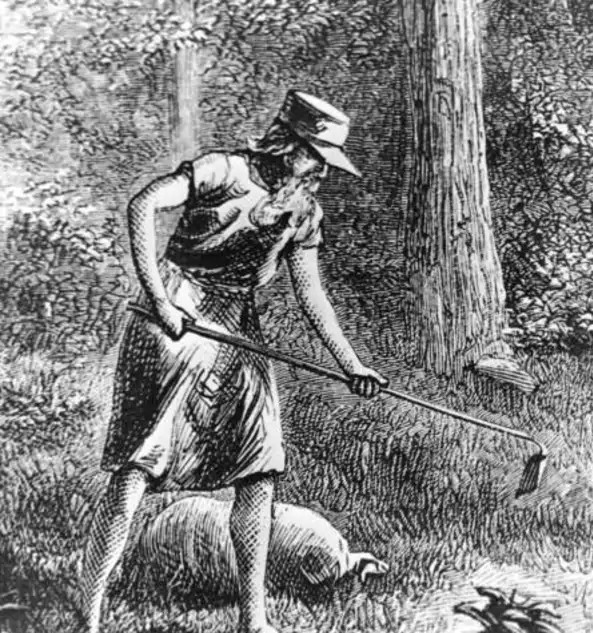
John Chapman (aka Johnny Appleseed), born in Leominster, Massachusetts joined Emanuel Swedenborg’s “New Church” as an itinerant missionary and in 1775 began travelling the country from Pennsylvania west into Ohio and Indiana. Trained as an apprentice orchardman, Chapman funded his travels by planting apple nurseries in communities along his way. He would plant seeds, fence in the nursery, and sell the land to a farmer. Chapman taught the farmers how to tend to the trees, and how to sell the young trees to other farmers interested in starting orchards.
One of the few comfort foods reminiscent of home, apples were an important part of the diet of early settlers. Apples and pears provided a high yield density of calories and a source of vitamens. From the perspective of an early settler, a person needed apples to feed his large family. Apples were eaten fresh, fried, stewed, and baked; made into cider, vinegar and brandy; dried in the sun or in a heated dryhouse, and made into preserves and apple butter. Even mediocre apples could be used in some form and the worst of the fruit was used as livestock feed. They attempted to grow enough apples to consume fresh from the fall through the winter. Primitive storage was accomplished by storing the apples in insulated pits. The larger portion of the crop was consumed as juice and (fermented) cider. An established farmer might put up 20 to 50 barrels of cider each fall.
Apples and cider (and stronger) were often associated with evening social gatherings where participants “enjoyed apple, smoked their pipes with cider thrown in!” “Apple Cuts” were occasions during the fall where young men and women gathered to socialize and prepare apples for sauce and pies.
______________________